
Non-Invasive Diagnostics in Diabetes Care: Tracking Beta Cell Function and Recovery

In the field of diabetes care, the tools used for diagnosis and monitoring have remained remarkably basic for decades. Most patients are familiar with standard blood tests: fasting blood glucose, post-prandial blood glucose, and Hemoglobin A1c (HbA1c). While these tests are highly useful for measuring the amount of sugar circulating in the blood, they are fundamentally limited. They only describe the symptom of the disease—hyperglycemia—but they tell us nothing about the underlying health of the organs responsible for regulating metabolism. They cannot show how much insulin the pancreas is actively producing, whether the insulin receptors on the body's cells are responsive, or if the pancreatic tissue is experiencing chronic inflammation or cellular damage. Managing diabetes based solely on blood sugar readings is like trying to fix a complex car engine by only looking at the speedometer; it tells you how fast you are going, but not why the engine is malfunctioning.
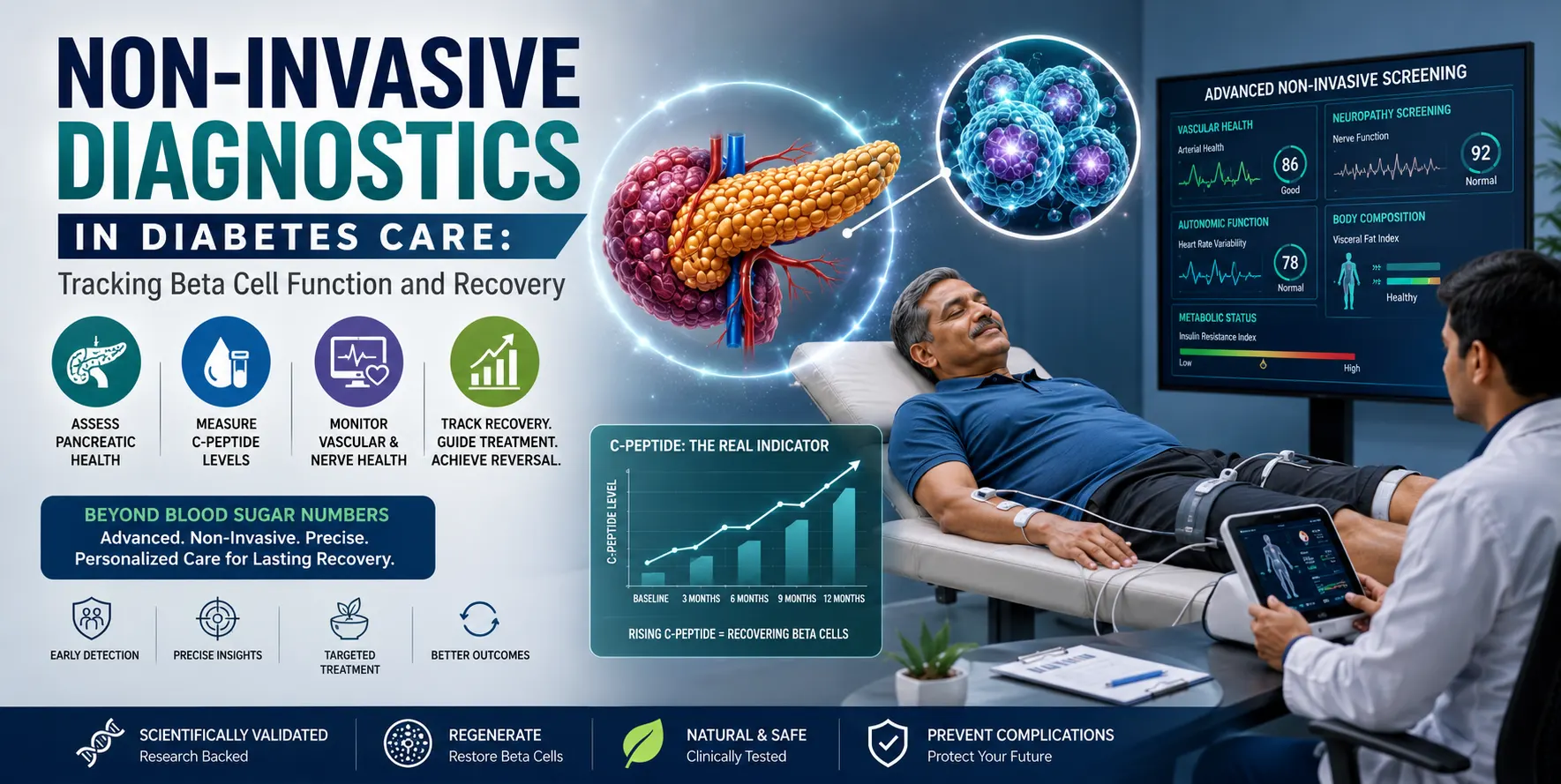
To achieve true clinical reversal and guide the process of beta cell regeneration, we must move beyond simple blood sugar readings and adopt a precision diagnostics approach. We need to look inside the body at a cellular level to understand the functional status of the pancreas. At the Glycemia Anti-Diabetic Clinic, this is achieved through the use of advanced, non-invasive diagnostic technologies. By precisely measuring biomarkers like C-peptide and utilizing state-of-the-art screening systems, the clinic's medical team can assess pancreatic health, detect early signs of vascular and nerve complications, and track the recovery of beta cells in real-time. This data-driven approach allows for the creation of personalized, highly effective treatment protocols that address the specific metabolic needs of each patient. This article will explore the role of advanced diagnostics in diabetes care, explain how we measure beta cell function, and examine how technology guides the regeneration journey.
When assessing pancreatic health, one of the most critical biomarkers is C-peptide. When the beta cells in the pancreas synthesize insulin, the hormone is initially created as a larger molecule called proinsulin. Before it is released into the bloodstream, proinsulin is cleaved by enzymes into two active parts: one molecule of insulin and one molecule of C-peptide (connecting peptide). Both molecules are secreted into the blood in equal amounts (a 1:1 ratio). While insulin is rapidly cleared and metabolized by the liver, C-peptide remains stable in the bloodstream for a longer period, making it a highly reliable indicator of endogenous insulin production. By measuring C-peptide levels through a simple blood test, doctors can determine exactly how much insulin the patient's pancreas is actively secreting. This test is essential for several reasons:
In addition to C-peptide testing, Glycemia Anti-Diabetic Clinic utilizes a suite of advanced, non-invasive diagnostic technologies to evaluate metabolic and vascular health. These technologies, detailed on the clinic's advanced diagnostic technology page, allow for a comprehensive assessment of the patient's body within minutes, without causing pain or discomfort. These screening tools assess several critical parameters:
To understand the depth of the diagnostic protocols at Glycemia Anti-Diabetic Clinic, it is helpful to look at how these screening systems operate in practice. During a standard patient evaluation, the clinical team uses advanced bio-impedance and photoelectric sensors to measure the health of the cardiovascular and nervous systems. These tests are completely non-invasive, taking only a few minutes to complete, yet they provide vital data that traditional blood tests miss. For instance, the vascular screening system measures arterial wave forms to calculate the pulse wave velocity (PWV), which is a key indicator of arterial stiffness. Because chronic high blood sugar causes damage to the blood vessel linings (endothelial dysfunction), detecting arterial stiffness early allows the medical team to implement protective therapies before the patient develops serious cardiovascular issues.
Similarly, the neurological screening system evaluates the autonomic nervous system by measuring heart rate variability (HRV) under different breathing conditions. This helps detect autonomic neuropathy, a type of nerve damage that can affect the heart, digestive system, and bladder. For peripheral neuropathy, the system measures the galvanic skin response of the feet, which correlates with the function of the small sweat gland nerves. Nerve damage of this type is a leading cause of diabetic foot ulcers and eventual amputations. By detecting these complications in their sub-clinical stages—long before the patient feels any numbness or pain—the clinic can introduce targeted regenerative therapies to repair the nerves and blood vessels, preventing irreversible damage and significantly improving the patient's long-term prognosis.
Furthermore, the integration of these diagnostics with the clinic's treatment protocols allows for highly personalized medicine. Every patient's body responds differently to metabolic stress and healing. By performing periodic screenings, the clinical team can see exactly how the patient's blood vessels, nerves, and pancreas are responding to the regenerative therapies. If a patient's vascular health is improving but their nerve function is lagging, the supplement and therapy protocols can be adjusted to prioritize nerve repair. This level of precise, evidence-based customization is what sets Glycemia Anti-Diabetic Clinic apart, transforming diabetes care from a guessing game into a targeted, measurable journey toward recovery.
The clinical diagnostic protocols and treatment outcomes at Glycemia Anti-Diabetic Clinic are backed by rigorous scientific research. The clinic maintains a strong collaborative relationship with the Amala Cancer Research Center in Thrissur, Kerala. As a prestigious research institution approved by the Indian Council of Medical Research (ICMR) and the Council of Scientific and Industrial Research (CSIR), the Amala Cancer Center has conducted laboratory evaluations of the clinic's natural formulations. These studies have confirmed that the clinic's treatments are non-toxic, protect pancreatic cells from oxidative damage, and support the regeneration of islet tissue. This collaborative validation ensures that the clinical progress tracked through the clinic's diagnostic tools is aligned with rigorous, peer-reviewed scientific standards. By combining state-of-the-art diagnostic technology with validated natural therapies, Glycemia Anti-Diabetic Clinic provides a safe, scientific, and highly effective pathway to diabetes reversal. If you are ready to look beyond simple blood sugar readings and get a complete picture of your metabolic health, contact Glycemia Anti-Diabetic Clinic in Kannur to schedule your comprehensive screening today.