
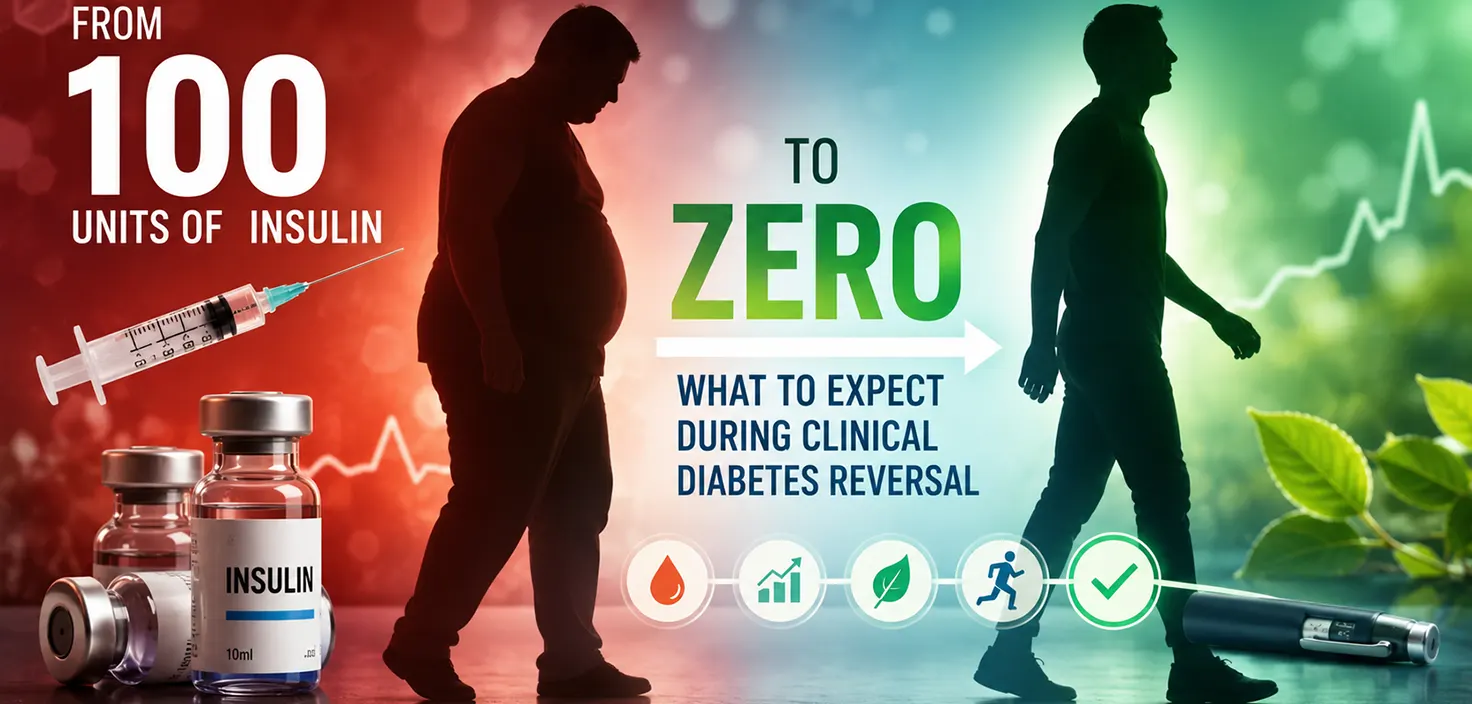
From 100 Units of Insulin to Zero: What to Expect During Clinical Diabetes Reversal

For someone taking 80, 100, or even more units of insulin every day, the idea of reducing insulin—or potentially reaching a point where insulin is no longer required—can sound almost impossible.
Yet, for some people with Type 2 diabetes, major improvements in blood glucose control and insulin requirements are possible.
This process is often called diabetes reversal, although the more medically accepted term is Type 2 diabetes remission.
The journey does not happen in one dramatic moment. It is usually a gradual process involving better glucose control, reduced insulin resistance, changes in body weight and metabolism, careful medication adjustment, and continuous monitoring.
Some people may reduce insulin significantly. Some may eventually stop insulin under medical supervision. Others may continue to require insulin or other diabetes medication despite making excellent progress.
Every person is different.
This article explains what the journey from high-dose insulin dependence toward improved metabolic health may look like, milestone by milestone.
The word “reversal” is widely used, but it can create confusion.
Diabetes does not disappear from a person's medical history simply because blood glucose becomes normal.
For Type 2 diabetes, an international expert consensus defines remission as an HbA1c below 6.5% that continues for at least three months without the use of usual glucose-lowering medication.
Remission is not the same as a guaranteed permanent cure.
Blood glucose can rise again in the future, particularly if the metabolic factors contributing to diabetes return. Therefore, regular monitoring remains important even after remission.
It is also essential to understand that this discussion mainly applies to Type 2 diabetes.
Type 1 diabetes is an autoimmune disease in which the immune system attacks insulin-producing beta cells. A person with Type 1 diabetes should never stop insulin based on a reversal programme or general health advice.
A high insulin requirement does not automatically mean that the pancreas has completely stopped producing insulin.
In many people with Type 2 diabetes, the major problem is insulin resistance.
This means the body has insulin, but muscle, liver, and fat cells do not respond to it efficiently.
Imagine insulin as a key and the cell as a door.
In a healthy insulin-sensitive body, one key may open the door easily. In severe insulin resistance, the lock becomes difficult to operate. The body may need much more insulin to achieve the same effect.
Over time, a person may progress through a treatment journey such as:
Lifestyle modification
One oral diabetes medicine
Multiple medicines
Basal insulin
Increasing insulin doses
Multiple daily insulin injections
High total daily insulin requirements
For example, a person may take 50 units in the morning and 50 units in the evening. Another person may use a combination of long-acting and mealtime insulin that totals 100 units or more per day.
If insulin sensitivity improves significantly, the same amount of insulin can become too much. This is why insulin reduction must be carefully monitored.
The first stage is not about immediately stopping insulin.
It is about understanding the person's current condition.
A proper clinical assessment may include:
Fasting blood glucose
Post-meal glucose
HbA1c
Current insulin type and daily dosage
Other diabetes medications
Duration of diabetes
Frequency of low blood glucose episodes
Body weight and waist measurement
Kidney function
Liver health
Blood pressure
Lipid profile
Eating pattern and physical activity
C-peptide testing in selected cases
This creates a baseline.
Consider a person named Rajesh who has lived with Type 2 diabetes for 12 years.
He currently takes a total of 100 units of insulin daily. His blood glucose remains high despite this dose.
The first question should not simply be, “How quickly can we stop insulin?”
Better questions are:
Why is the insulin requirement so high?
How severe is the insulin resistance?
How much insulin is the pancreas still producing?
Are there dietary patterns causing major glucose spikes?
Is the person experiencing unrecognised hypoglycaemia?
Are there other health conditions affecting glucose control?
A safe remission-focused programme begins with measurement, not assumptions.
During the early phase of a structured programme, blood glucose patterns may begin to change.
The exact timeline varies widely.
Some people may notice improved glucose readings relatively quickly after significant dietary changes and weight loss. For others, improvement is slower.
At this stage, the body may begin experiencing:
Smaller post-meal glucose rises
Lower fasting glucose
Improved response to insulin
Reduced glucose variability
Fewer extreme glucose readings
This stage requires careful monitoring.
If insulin sensitivity improves while the person continues taking the same large insulin dose, blood glucose may fall too low.
Symptoms of low blood glucose may include:
Sweating
Shaking
Sudden hunger
Dizziness
Confusion
Weakness
Rapid heartbeat
Difficulty concentrating
Medication and insulin adjustments should therefore be made by the treating medical team based on glucose data.
The goal is not to reduce insulin as quickly as possible. The goal is to maintain safe glucose levels while the body's requirements change.
For a person responding well to treatment, the next important milestone may be a gradual reduction in insulin requirements.
Imagine someone beginning at 100 units per day.
Their journey might look something like:
100 units → 90 units → 75 units → 60 units → 40 units → 20 units → further reassessment
This is only an illustration. It is not a recommended insulin reduction schedule.
Real insulin adjustments depend on glucose readings, HbA1c, meal patterns, activity, other medications, illness, kidney function, and many other factors.
Several changes may contribute to a reduced insulin requirement.
The body may begin responding more effectively to insulin.
This means less insulin is required to achieve the same glucose-lowering effect.
The liver stores and releases glucose. In Type 2 diabetes, the liver may release excessive glucose into the bloodstream, particularly overnight.
Improved metabolic health can help reduce inappropriate glucose production.
Changes in food quality, portion size, meal timing, and total energy intake may reduce large glucose spikes.
Better glucose control can reduce glucotoxicity—the harmful effect of prolonged high glucose exposure on tissues, including pancreatic beta cells.
The important point is that the falling insulin requirement is usually the result of several changes working together.
As progress continues, some people notice that their previous insulin dose has a much stronger effect.
This can be an important turning point.
For example, suppose 20 units of insulin previously reduced glucose only slightly. After substantial metabolic improvement, the same 20 units might cause glucose to fall much more sharply.
This does not mean insulin has suddenly become stronger.
It means the body's response to insulin may have improved.
Lower fasting glucose
Smaller post-meal glucose spikes
Lower average glucose
Reduced insulin requirements
Improved HbA1c over time
Improved triglycerides in some people
Reduction in waist circumference
Improved energy levels
Not every person experiences every improvement, and laboratory results should always be interpreted in the context of the complete clinical picture.
For someone who started with a high daily insulin requirement, reaching a low dose can be psychologically significant.
But this stage requires patience.
The difference between going from 100 units to 80 units and going from 10 units to zero can be substantial.
At lower doses, the medical team needs to evaluate whether the person's own insulin production is sufficient to maintain safe glucose levels without injected insulin.
This may involve reviewing:
Fasting glucose trends
Post-meal glucose trends
Continuous glucose monitoring data, if available
HbA1c
Frequency of hypoglycaemia
C-peptide results in selected situations
Current diet and activity pattern
Other glucose-lowering medications
The decision should be based on objective evidence rather than the desire to reach “zero insulin” by a particular date.
For some people with Type 2 diabetes, the clinical team may eventually decide that injected insulin can be stopped.
This should be a supervised decision.
The person may still require other glucose-lowering medication, depending on their individual condition.
In other cases, glucose may remain controlled without glucose-lowering medication.
The first few days and weeks after insulin withdrawal require careful observation.
Important measurements may include:
Morning fasting glucose
Glucose before meals
Post-meal glucose when advised
Symptoms of high or low glucose
Body weight
HbA1c at the appropriate follow-up interval
Stopping insulin is an important milestone, but it is not the end of the journey.
A person is not considered to be in remission simply because they stopped insulin yesterday.
According to international expert consensus, the usual remission criterion is an HbA1c below 6.5% measured at least three months after stopping glucose-lowering medication.
This waiting period is important because HbA1c reflects average glucose exposure over approximately the previous two to three months.
A person who has stopped insulin but is still taking other glucose-lowering medication may have excellent diabetes control, but this does not meet the usual consensus definition of drug-free remission.
That distinction is important.
The main goal of diabetes care should be better long-term health—not simply collecting the label of remission.
People often imagine diabetes reversal as a rapid healing process.
In reality, the body may be undergoing several gradual adjustments.
Muscle and other tissues may use glucose more efficiently as insulin sensitivity improves.
When insulin resistance decreases, the pancreas may not need to work as hard to meet the body's insulin requirements.
Improved liver metabolism may reduce excessive glucose release into the bloodstream.
For people carrying excess weight, meaningful weight loss can improve metabolic health. Evidence from remission programmes has shown that substantial weight loss can help some people with Type 2 diabetes achieve remission.
However, not everyone with Type 2 diabetes has the same underlying biology, and weight loss does not guarantee remission for every individual.
Not everyone taking insulin will be able to stop it.
Factors that can influence the likelihood of remission include:
Longer duration of Type 2 diabetes
Reduced remaining beta-cell function
Severe insulin resistance
Difficulty maintaining metabolic improvements
Weight regain
Certain medications
Other medical conditions
Genetic factors
Age-related changes
Inconsistent follow-up
This is why comparing one person's journey with another can be misleading.
One person may reduce insulin dramatically within months. Another may improve their HbA1c and reduce insulin by 30% but still need ongoing insulin therapy.
Both outcomes can represent meaningful health improvement.
A headline such as “100 units to zero” is powerful because it represents a dramatic transformation.
But clinically, zero insulin should not become an obsession.
Consider two people.
Person A stops insulin but has poorly controlled blood glucose.
Person B continues a small amount of insulin but has stable glucose, a healthy HbA1c, fewer glucose fluctuations, and a lower risk of complications.
Person B may have the better clinical outcome.
The real goals are:
Safe and stable blood glucose
Lower risk of complications
Better metabolic health
Sustainable eating habits
Appropriate body weight
Regular physical activity
Better quality of life
Reduced medication burden when medically appropriate
Medication reduction is valuable when it happens safely as a result of genuine metabolic improvement.
Remission requires continued attention.
Type 2 diabetes can return.
Weight regain, declining physical activity, illness, ageing, and other metabolic changes may cause blood glucose to rise again.
A person in remission should continue regular health checks.
These may include:
Periodic HbA1c testing
Blood pressure monitoring
Kidney health checks
Eye examinations
Foot health assessments
Cholesterol monitoring
Weight and waist monitoring
Review of diet and physical activity
Remission should be seen as a new phase of long-term health management, not permission to return to the habits or conditions that contributed to metabolic problems.
A person using a large amount of insulin should never suddenly reduce or stop it without medical supervision.
This is especially important because different forms of diabetes require different treatment approaches.
The person may have:
Type 1 diabetes
Type 2 diabetes
LADA or slowly progressing autoimmune diabetes
Pancreatic diabetes
Steroid-induced diabetes
Another less common form of diabetes
The correct diagnosis matters.
A safe clinical programme should use medical history, glucose monitoring, laboratory investigations, medication review, nutritional guidance, and ongoing follow-up to create an individual plan.
The journey from 100 units of insulin to zero is possible for some people with Type 2 diabetes, but it is not a guaranteed or universal pathway.
The process usually happens through milestones: detailed assessment, improved glucose patterns, increasing insulin sensitivity, carefully supervised insulin reduction, low-dose reassessment, possible insulin withdrawal, and long-term monitoring.
For some people, the final destination may be Type 2 diabetes remission. For others, success may mean taking much less insulin, achieving better HbA1c levels, reducing glucose fluctuations, losing excess weight, and lowering the risk of future complications.
The most important lesson is that diabetes improvement should be measured by the health of the whole person—not simply by how quickly an insulin dose reaches zero.
Clinical progress requires patience, careful monitoring, realistic expectations, and an individualised approach.
Some people with Type 2 diabetes may be able to significantly reduce or eventually stop insulin if their metabolic health and glucose control improve sufficiently. This is not possible for everyone and should only happen under medical supervision.
There is no standard timeline. Some people experience changes relatively quickly, while others require many months or longer. The timeline depends on the type and duration of diabetes, insulin resistance, remaining insulin production, weight changes, diet, activity, and other health factors.
No. Stopping insulin alone does not prove remission. A person may still require other glucose-lowering medication. The usual international consensus definition of Type 2 diabetes remission is HbA1c below 6.5% for at least three months without usual glucose-lowering medication.
Do not change insulin doses independently. Improved insulin sensitivity can increase the risk of hypoglycaemia if insulin is not adjusted appropriately. Dose changes should be discussed with the treating medical professional.
Yes. Type 2 diabetes can return after a period of remission. Regular glucose monitoring, healthy eating, physical activity, weight management where appropriate, and ongoing medical check-ups remain important.